Why Goliath Struggles and David Does Not Lose : The Logic of the U.S.-Iran War
History is full of wars that resemble David versus Goliath: conflicts in which one side possesses overwhelming material superiority while the other is vastly weaker in conventional military terms. The intuitive expectation is straightforward — the stronger state should win. For much of modern history, that expectation held true. As Arreguín-Toft (2005) observes, strong actors historically won a clear majority of asymmetric conflicts. Yet, that broad pattern obscures a major modern shift: wars between the strong and the weak have become increasingly unpredictable, and the weak have become far more capable of avoiding outright defeat.
This essay argues that the key to understanding this shift lies not in raw military power, but in the complex relationship between war aims, time, and strategy. Strong states often enter asymmetric wars with immense destructive capacity, yet frequently struggle to translate battlefield superiority into durable political outcomes. Weak states, by contrast, may be unable to defeat the strong conventionally, but they can still successfully deny them victory. In this sense, modern asymmetric wars are not best understood as cases where David wins outright, but rather where Goliath fails to achieve his original political objectives. In the realm of asymmetric warfare, “not losing” is a profoundly meaningful strategic outcome.
Wars that are neither clear victories nor clear defeats
It is often more accurate to state that the weak do not lose, or that the strong fail to win, than to frame these conflicts in absolute terms of victory and defeat. This ambiguity stems directly from the nature of war aims. Sullivan (2007) argues that war outcomes are shaped by the interplay of two factors: Destructive capacity and Cost tolerance. Destructive capacity refers to the ability to coerce through military means — technology, training, doctrine, and firepower. Cost tolerance refers to a state’s willingness to absorb casualties, financial burdens, political backlash, and extended timelines. The crucial point is that destructive capacity is relatively visible before war begins, while cost tolerance is much harder to observe. States can count tanks, aircraft, and missiles more easily than they can predict how long an opponent will endure punishment.
This matters especially in wars whose success depends on enemy compliance. In many asymmetric conflicts, the strong state does not merely seek to destroy armed units. It seeks to compel a weaker actor to change behavior, surrender political control, stop supporting insurgents, accept occupation, or comply with a new political order. Those goals depend not only on physical destruction but also on the target’s willingness to yield. If the weaker side refuses to comply indefinitely, even while suffering tactical losses, then the cost of victory rises in ways that are difficult to estimate beforehand. Sullivan’s broader argument is precisely that as war aims depend more heavily on target compliance, uncertainty about the cost of victory grows, and relative resolve becomes more consequential.
Seen this way, strong states do not necessarily struggle in asymmetric war because they lack firepower or even because they lack resolve in some absolute sense. They struggle because they misjudge how costly compliance will be to extract. Once the political, economic, and human costs of achieving the original objective exceed what leaders and publics were willing to pay, the strong state often scales back, narrows its goals, or withdraws. The weaker side, meanwhile, does not need to destroy the stronger actor’s military. It often needs only to survive long enough for the stronger actor’s patience to erode. That is why so many asymmetric wars end not with triumphant conquest, but with exhausted stalemate, mission drift, or strategic retrenchment.
The Strategic Weapon: Time
Arreguín-Toft’s central insight is that strategic interaction dictates outcomes more than raw power. He categorizes strategies into two approaches: Direct (targeting the opponent’s capacity to fight) and Indirect (targeting the opponent’s will to fight by avoiding decisive battles and imposing continuous costs). When both sides use similar strategic approaches, the strong actor usually prevails. However, when the weak side adopts the opposite approach — refusing the battlefield terms preferred by the strong — its prospects improve dramatically. Historically, strong actors win roughly 76.8 percent of same-approach interactions, while weak actors win about 63.6 percent of opposite-approach interactions.
| Direct Defense | Indirect Defense | |
|---|---|---|
| Direct Offense | Strong favored | Weak favored |
| Indirect Offense | Weak favored | Strong favored |
This is not a mechanical law, but it captures an important tendency in asymmetric conflict: when the weak refuse the strong actor’s preferred mode of war, conflict becomes protracted, and time begins to work against the stronger state.
Time matters because the two sides typically value the war differently. Mack (1975)’s classic argument about “interest asymmetry” remains useful here. For the weak actor, the war is often existential. Survival, sovereignty, and political community are at stake. That tends to generate a stronger consensus around sacrifice. For the strong actor, by contrast, the war is often limited rather than existential. Other national priorities remain in play, and the conflict competes with domestic political concerns. In such cases, prolonged war increases political vulnerability: casualties mount, financial costs accumulate, legitimacy erodes, and publics begin asking what exactly is being gained in exchange for continued sacrifice.
This is why time is not just a background variable in asymmetric war; it is itself a strategic weapon. The weak side may lose territory, equipment, and population in the short run, yet still improve its long-run position by extending the war. The longer the conflict continues, the more likely it becomes that divisions emerge within the strong actor’s leadership, legislature, media system, and public. What begins as a military campaign gradually turns into a political test of endurance. In this sense, the weak transform time into leverage. They survive, absorb, delay, and wait for the stronger power’s coalition of support to fray.
External support and the extension of war
Record (2007) adds another major factor: foreign help. In his account of insurgent victories against major powers, external assistance emerges as one of the most consistent correlates of success for the weak. Foreign aid can provide money, sanctuary, weapons, intelligence, recruits, and diplomatic cover. More importantly, it lengthens the war. And because time often benefits the weak side politically, foreign support magnifies the structural problem faced by the strong. Record’s broader warning is that great powers, especially democracies fighting for non-core interests, are particularly vulnerable when insurgencies can outlast them politically and strategically.
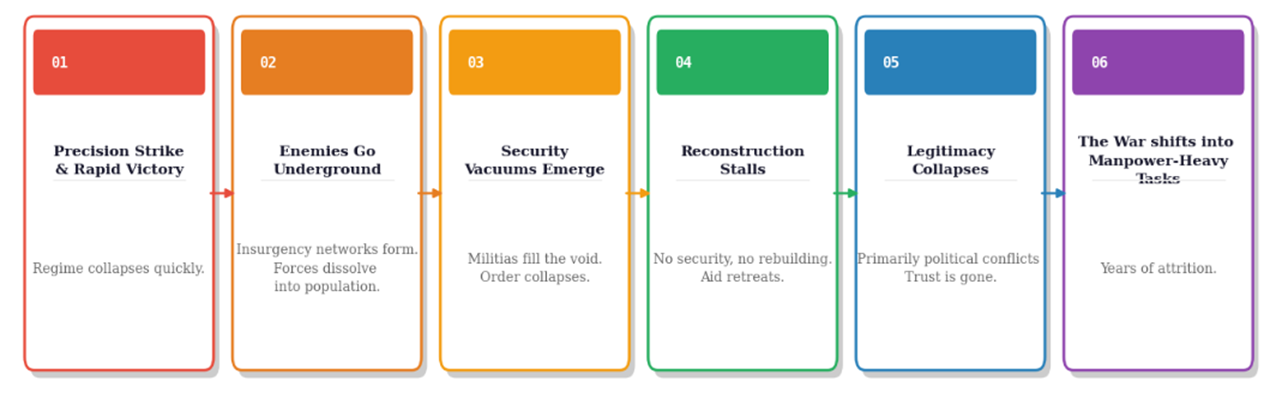
Record is especially skeptical of interventions that seek quick battlefield success without investing in the slow and manpower-intensive political work required to turn military gains into lasting order. That critique resonates with a wider literature on limited war and counterinsurgency. The problem is not merely insufficient force. It is the mismatch between ambitious political aims and short time horizons. If defeating an insurgency or transforming a political order requires long-term engagement, but the intervening power’s political culture demands rapid closure, then strategy becomes internally contradictory from the start.
Why modern military superiority can become a liability
The puzzle deepens further in the post-1945 period because technological superiority does not always solve the problem. Lyall and Wilson (2009) argue that higher levels of mechanization can actually reduce effectiveness in counterinsurgency environments. Mechanized forces depend on extensive fuel, maintenance, spare parts, and secure logistics. They become base-centric and vehicle-centric. That often reduces routine contact with local populations and increases social distance between soldiers and civilians. The result is informational isolation: the stronger army struggles to distinguish insurgents from noncombatants, which is precisely the identification problem at the heart of counterinsurgency warfare.
Their paired comparison of two U.S. Army divisions in Iraq illustrates the mechanism. The heavily mechanized 4th Infantry Division relied more on mounted patrols and large-scale arrests and experienced worsening attacks, while the more lightly mechanized 101st Airborne conducted more dismounted patrols, developed local intelligence networks, and achieved comparatively better outcomes. More broadly, their cross-national findings suggest that higher mechanization, insurgent external support, and the counterinsurgent’s status as an occupier are all associated with a greater probability of state defeat. In other words, the very technologies that make strong states formidable in conventional war can, under certain conditions, help the weak by widening the social and informational gap between intervening forces and the population they need to understand.
This is one of the central ironies of modern asymmetric war. Superior military technology may destroy more targets more efficiently, yet still fail to generate the political knowledge required for lasting control. And when civilian alienation increases, insurgents gain room to maneuver. Security vacuums deepen, coercive measures become blunter, and domestic support inside the strong state can weaken further as the war appears both costly and strategically incoherent.
The Fallacy of the World War II Analogy
One common response is to assume that overwhelming force followed by occupation can solve the problem. But Edelstein (2004)’s work cautions strongly against treating post-1945 Germany and Japan as normal cases. Military occupations have historically been difficult and often unsuccessful. In Edelstein’s larger universe of occupations since 1815, only a small minority succeeded fully. He argues that occupations are most likely to succeed under unusual conditions: when the occupied population sees occupation as necessary, when both occupier and occupied recognize a common external threat, and when the occupier can credibly signal that it will eventually withdraw and restore sovereignty.
Those conditions help explain why Germany and Japan were exceptional rather than typical. In both cases, the occupation occurred in the shadow of a larger geopolitical threat and under circumstances that made the occupier’s presence more tolerable than it otherwise would have been. Edelstein’s broader point is that occupation is not simply a matter of troops and resources. It is a political relationship that depends on legitimacy, patience, and credible commitment. Without those conditions, occupation tends to become increasingly costly for both the occupier and the occupied, while nationalist resistance and impatience grow over time.
The U.S.–Iran war through the lens of asymmetric conflict
At the time of writing in early March 2026, the U.S.-Israeli war against Iran is still unfolding, and any firm prediction would be premature. Still, the existing literature on asymmetric conflict provides a useful way to interpret the strategic choices now visible. Reporting from the Associated Press , The New York Times, and Reuters highlights a widening conflict, rising pressure in Washington over strategy and exit plans, and a shifting set of publicly stated U.S. objectives, ranging from denying Iran nuclear capability, to degrading its military, to influencing succession politics, to discussing the terms on which the war might end. That fluidity does not by itself mean failure, but it does suggest uncertainty about what political end state is actually being pursued.
| Direct Defense | Indirect Defense (Iran) | |
|---|---|---|
| Direct Offense (US) | Strong favored | Weak favored |
| Indirect Offense | Weak favored | Strong favored |
From Iran’s perspective, the strategic logic is clear. Given overwhelming U.S. conventional superiority, a direct conventional defense would be the least promising option. The more plausible path is an indirect defense: survive, disperse, raise the cost of continued operations, widen the theater where possible, and transform the military confrontation into a broader regional and political burden. Recent reporting suggests that Tehran has tried to impose costs not only through military retaliation but also by targeting the Gulf’s economic lifelines and threatening energy and shipping routes — a strategy known as “Operation Madman.” These moves appear designed to make the war more expensive not just for the United States and Israel, but also for neighboring states whose pressure on Washington could matter politically.
In that respect, the conflict already reflects a classic asymmetric logic. If the weak cannot defeat the strong on the battlefield, they can still seek to make the continuation of war politically and economically intolerable. Reuters has reported that the war threatens weeks or months of higher fuel prices even if it ends quickly, while U.S. political debate has already focused on casualties, costs, escalation, and the possibility of a prolonged conflict. That does not prove that Iran’s strategy will succeed. In fact, some analysts cited by Reuters argue that attacks on Gulf states may backfire by pushing them closer to Washington. But it does show that the central battlefield is no longer only military. It is also temporal, economic, regional, and political.
The deeper paradox, then, is that the strong state may seek quick coercive success in a kind of war whose structure rewards patience, adaptation, and political endurance. If the United States wants more than punitive strikes — if it seeks enduring compliance, leadership change, strategic realignment, or long-term regional transformation — then the gap between military means and political ends becomes the decisive question. The literature on asymmetric war suggests that this is exactly where strong states most often run into trouble.
Conclusion
The central lesson of asymmetric war is not that the weak are stronger than they appear, nor that military power no longer matters. Military power still matters enormously. Strong states usually retain the capacity to devastate weaker ones, destroy infrastructure, and dominate conventional battlefields. But destructive capacity alone does not guarantee political success. In wars that depend on coercion, compliance, occupation, or regime transformation, time and cost tolerance become decisive. The weak often do not need to win militarily. They need only to deny the strong a politically sustainable victory.
That is why so many modern Davids do not lose. They turn time into a weapon, strategy into asymmetry, and survival into success. The real question in contemporary asymmetric war is therefore not simply who can destroy more. It is who can endure longer, adapt more effectively, and keep political purpose aligned with military action. Whenever the stronger actor cannot answer that question clearly, Goliath’s power may remain overwhelming on paper while still proving insufficient in practice.
References
Arreguín-Toft, I. 2005. How the Weak Win Wars: A Theory of Asymmetric Conflict. Cambridge University Press.
Edelstein, D. M. 2004. “Occupational Hazards: Why Military Occupations Succeed or Fail.” International Security.
Lyall, J., & Wilson, I. H. III. 2009. “Rage Against the Machines: Explaining Outcomes in Counterinsurgency Wars.” International Organization, 63(1), 67–106.
Mack, A. 1975. “Why Big Nations Lose Small Wars: The Politics of Asymmetric Conflict.” World Politics, 27(2), 175–200.
Record, J. 2007. Beating Goliath: Why Insurgencies Win. Potomac Books.
Sullivan, P. L. 2007. “War Aims and War Outcomes: Why Powerful States Lose Limited Wars.” Journal of Conflict Resolution, 51(3), 496–524.
Associated Press. 2026 (Mar. 3). Tensions flare as lawmakers question Iran war’s costs, risks and strategy.
The New York Times. 2026 (Mar. 7). In War’s First Week, a Punishing Military Campaign With No Coherent Endgame.
Reuters. 2026 (Mar.3,5,6,7,8). Iran war threatens prolonged hit to global energy markets / Iran’s strikes on Gulf states may widen war against Tehran, analysts say / Trump says ending Iran war will be ‘mutual’ decision with Netanyahu / Trump rejects settling war with Iran, raises notion of eliminating all its potential leaders / Trump tells Reuters US must have a role in choosing Iran’s next leader / US not expanding military objectives in Iran, Hegseth says